
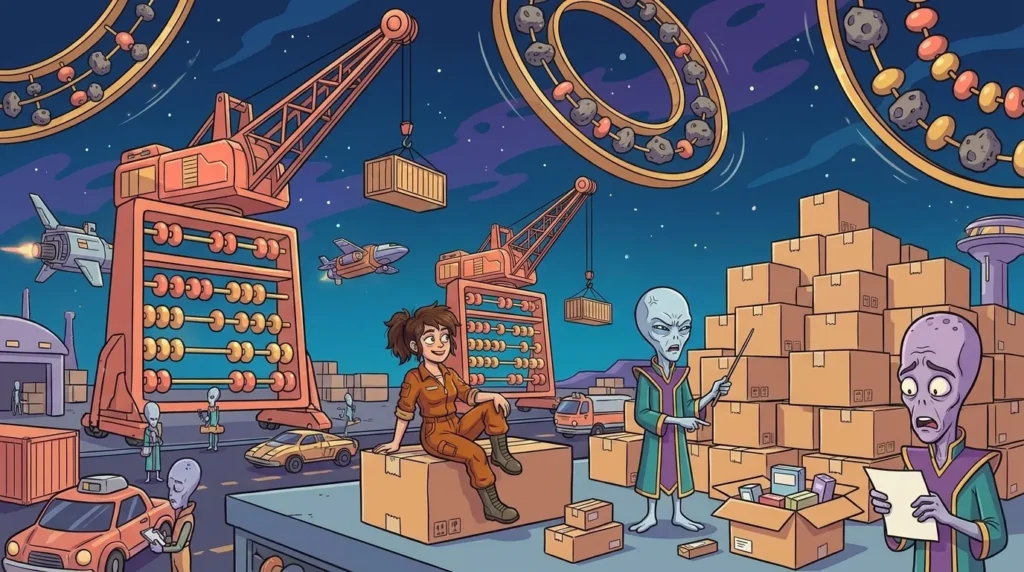
Kinesys materializes in the cargo port of Abakos, among cranes shaped like counting frames and giant abacus rings spinning in the sky. Here everything is counted, combined, and recombined: Abakians trade by barter and keep track of everything, even their sighs.
A warehouse worker, shipping manifest in hand, is staring at a stack of already sealed boxes. He has lost the sheet with the total, and he can’t reopen them without filling out twelve forms. Dord approves of the twelve forms. Liz, who was looking for someone to ask for directions, ends up counting boxes instead. M00N, ever so helpful, takes notes for everyone.
The Riddle
A warehouse worker is preparing a shipment of goods. We know that:
- each box, when completely full, holds either 8 large packages or 10 small packages;
- both large and small packages were shipped, for a total of 96 packages;
- there are more large packages than small ones.
How many boxes were used in all?
Hint
Call the number of small packages s and write the number of boxes in terms of s: it has to come out as a whole number. The condition on the large packages will help you rule out one of the possibilities.
Solution
The number of boxes is 11: 7 with large packages and 4 with small packages.
You can solve the problem by trial and error or with a system of equations. Let x be the total number of boxes, b the number of large (big) packages, and s the number of small packages:
x = b / 8 + s / 10
b + s = 96
b > s
Substituting b = 96 − s into the first equation gives:
x = 12 − s / 40
For x to be a whole number, s must be a multiple of 40. Since some small packages were shipped (s > 0) and s < 96, the only possible values are 40 and 80.
- With s = 40 we get x = 11 and b = 56: this is a valid solution, corresponding to 4 boxes of small packages and 7 boxes of large ones.
- With s = 80 we would get x = 10 and b = 16, which must be rejected because it violates the condition b > s.