
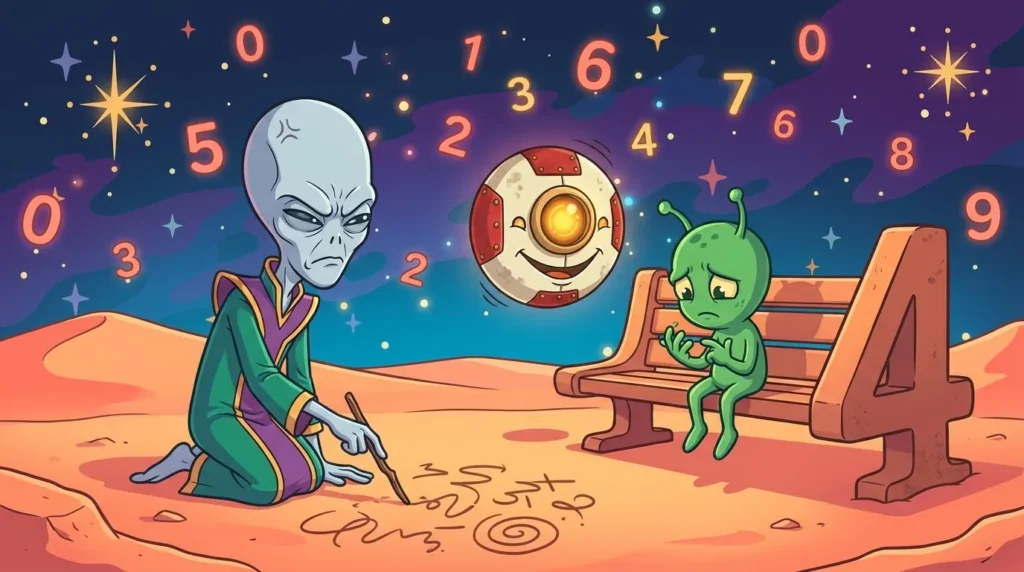
Kinesys was supposed to take them to Mars. Instead it materializes on Numerion where, as a consolation prize, there’s at least one Martian: he ended up there by mistake too, and sits glumly on a bench shaped like a 4.
M00N floats right over and gives him a smile: “Hi! Want to play a game?” To break the ice, Dord, who simply can’t go five minutes without doing math, writes a quadratic equation in the sand. The Martian solves it in a flash and proudly announces his result.
Dord redoes the calculation and goes pale: “That’s wrong. Absolutely wrong.” Liz, however, is watching the Martian’s hands as he counts: “Hold on, Dord. Maybe he isn’t wrong… maybe he just has a different number of fingers than we do.”
The Riddle
The Martian is given this equation:
x2 − 16x + 41 = 0
The Martian replies that the difference between the two roots is 10. How many fingers does the Martian have?
Hint
We count in base ten because we have ten fingers: the Martian writes numbers in his own base. Remember that in an equation of the form x2 − bx + c = 0, the sum of the roots is b and their product is c.
Solution
The Martian has 8 fingers. The trick is realizing that the Martian’s number of fingers is the base of his number system (we count in base 10 because we have ten fingers). So we need to find the base B in which, reading the numbers that way, everything adds up. Right away we can say the base is greater than 6, since the digit 6 appears in the equation.
A quick refresher on quadratic equations: if the roots of an equation are a and b and the coefficient of x2 is 1, the equation can be written like this:
(x − a)(x − b) = 0
that is:
x2 − (a + b)x + ab = 0
So the coefficient of x is the sum of the roots with its sign flipped, and the constant term is their product. Calling B the Martian’s base (written in base 10) and assuming a > b, we get:
a + b = (16)B = (B + 6)10
ab = (41)B = (4B + 1)10
a − b = (10)B = (B)10
Adding and subtracting the first and last relations gives:
a = (B + 3)10
b = (3)10
ab = [3(B + 3)]10 = [4B + 1]10
so 3B + 9 = 4B + 1, which means B = 8.
Check: rewriting everything in base 10, the equation becomes
x2 − 14x + 33 = 0
whose roots are x = 3 and x = 11. Their difference is 8, which in base 8 is written exactly as 10. Dord, for once, admits he was wrong. Quietly.