
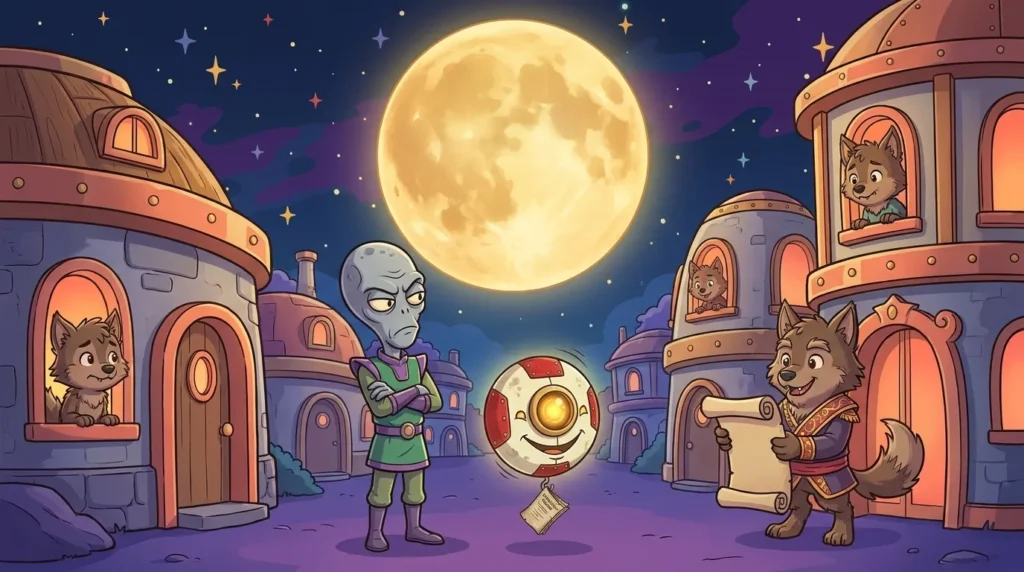
Kinesys lands in a village on Veritas just as an enormous, perfectly full moon is rising. M00N, who is shaped like a little moon herself, feels right at home. Then she notices that the villagers are eyeing it with some apprehension.
The mayor explains the situation with Veritasian frankness: the village has werewolves, and not one of them knows it. A recent ordinance aims to solve the problem without hurting anyone.
“A werewolf who doesn’t know he’s a werewolf,” Dord grumbles. “The height of irrationality.” Liz is worried about something else: “How many nights are we going to be stuck here?” The mayor looks at her. “That depends on how many wolves there are.”
The Riddle
A small village is plagued by werewolves: some people turn into wolves on full-moon nights. Every villager knows that at least one of them is a werewolf.
To deal with the situation, the mayor issues an ordinance: any citizen who discovers that they are a werewolf must report to the Lunar Clinic that same morning for treatment. Veritasians are extremely law-abiding: you can take it for granted that anyone who discovers they are a werewolf will report.
Unfortunately, a werewolf doesn’t notice their own transformation and can only figure it out by observing what happens around them. On every full-moon night (and only then), each citizen meets all the others and therefore sees who turns into a wolf, but cannot communicate with anyone.
After the third full-moon night, some werewolves report to the Lunar Clinic. How many are there, and why did they report only after the third night, when nobody had reported after the previous two?
Hint
Start with the simplest case: if there were only one werewolf, what would they see on the first night, and what would they conclude? Then move on to two wolves, keeping in mind what each one expects the other to do.
Solution
Exactly three werewolves report to the clinic.
Suppose there is only one werewolf in town. On the first full-moon night, they see no other wolf around. Knowing there is at least one, they realize the only wolf must be themselves, and they would report to the clinic after the first night. That doesn’t happen, so there is more than one wolf.
Now suppose there are two. On the first night, each of them sees exactly one wolf (the other one) and assumes it’s the only one, so each expects the other to report after the first night. That doesn’t happen, and on the second night the two wolves see each other again: each realizes there must be a second wolf, and since they can see only one, they must be the second. Both would report after the second night. Since nobody reports after the second night either, there aren’t two wolves.
So there are three. Each of the three sees two wolves and, by the reasoning above, expects those two to report after the second night. When they see them again on the third night, each realizes there must be a third wolf—and that the third wolf is themselves. All three report to the clinic after the third night.
The reasoning generalizes: if there were n werewolves, they would all discover themselves together after n full-moon nights.