
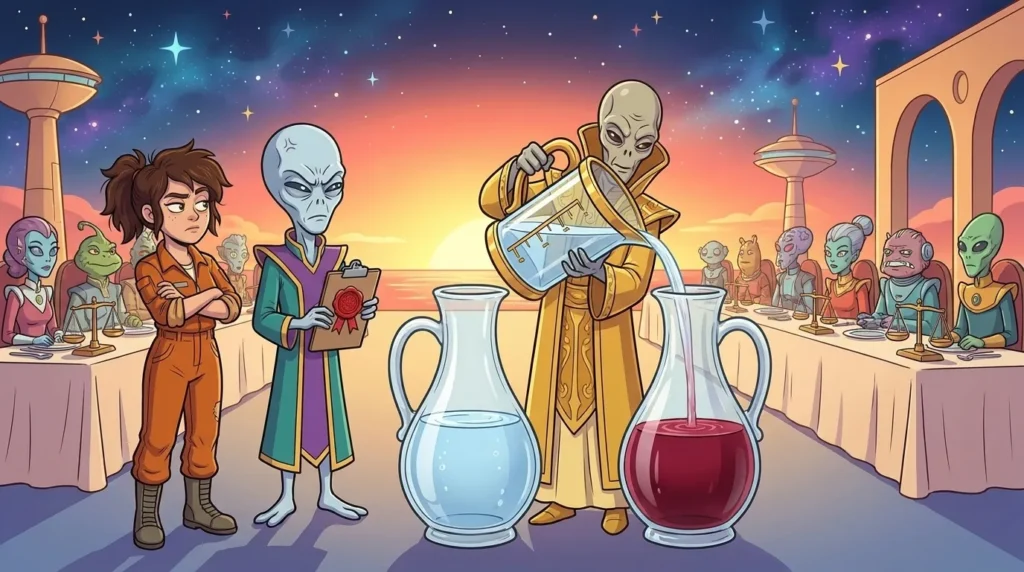
Staterion’s Feast of Fairness goes on, and the carafe problem gets more serious. Now there are two enormous carafes on the table, ten gallons each: one of water, one of wine.
The master of ceremonies has received an order from the Council of Scales: the two carafes must contain the same percentage of wine, so that no one is slighted. He can pour three gallons at a time, back and forth, as many times as he likes, stirring after each transfer.
Dord nods in satisfaction: “Finally, a sensible rule.” After the tenth transfer, Liz starts waltzing around the table to keep from dozing off. M00N has a suspicion: “What if we never get there?”
The Riddle
Another interesting problem with the carafes of water and wine. At the start, one carafe contains 10 gallons of water and the other 10 gallons of wine. By transferring 3 gallons back and forth any number of times, and stirring after each transfer, is it possible to reach a state in which the percentage of wine in the two mixtures is the same?
Hint
Suppose one carafe has a higher percentage of wine than the other. What happens to this inequality after a transfer in one direction? And after a transfer in the other?
Solution
Regardless of how much wine is in one carafe and water in the other, and of how much liquid is transferred back and forth each time (as long as the liquid doesn’t all end up in one carafe), it is impossible to reach a point where the percentage of wine is the same in both mixtures.
This can be proved with a simple inductive argument. Suppose carafe A has a higher concentration of wine than carafe B. A transfer from A to B leaves A with the higher concentration: B receives a mixture stronger than its own, but still ends up weaker than A. Likewise, a transfer from B to A (from a weaker mixture to a stronger one) certainly leaves B weaker. Since every transfer falls into one of these two cases, carafe A always holds a mixture with a higher percentage of wine than B. The only way to make the concentrations equal is to pour the entire contents of one carafe into the other.
There is, however, a flawed assumption in this solution: it presumes that liquids are infinitely divisible, when in reality they are made of discrete molecules. Dord finds this clarification simply marvelous.
Source: Martin Gardner, Mathematical Puzzles and Diversions (Italian edition: “Enigmi e giochi matematici”)