
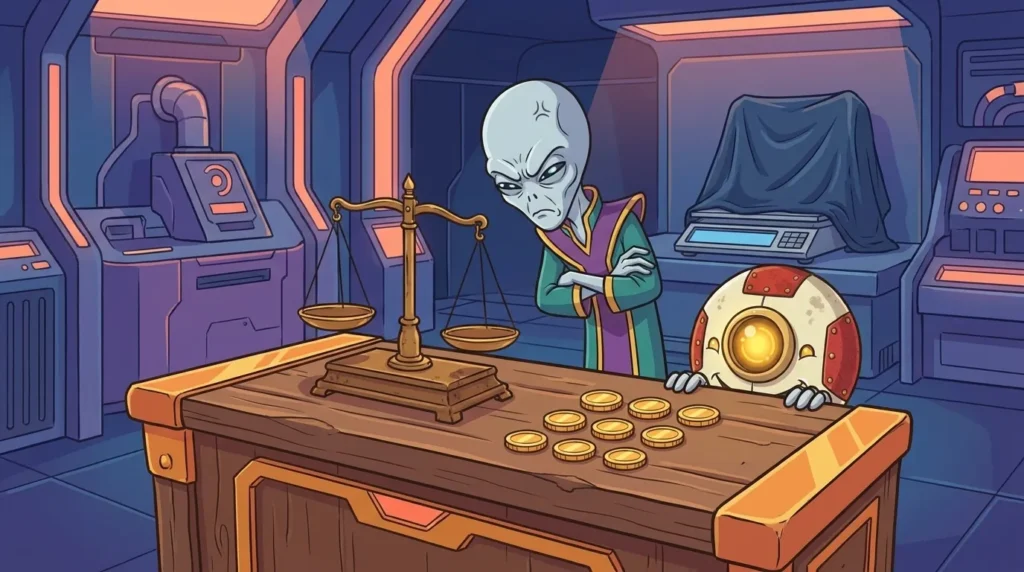
Kinesys is still humming in the courtyard of the Staterion Mint when the director comes running back: this time the counterfeiter left nine suspicious coins on the counter, and only one is fake, slightly heavier than the others.
The great digital scale, however, is out for maintenance. All that’s left is an old two-pan balance, the kind that only tells you which side is heavier. Dord regards it with almost religious respect: “At last, an honest instrument. No numbers, only truth.”
Liz, on the other hand, starts twirling between the pans to pass the time, until M00N calls her back: “Liz, I bet we need hardly any weighings at all!”
The Riddle
You have a two-pan balance and nine coins, one of which is slightly heavier than the others. What is the minimum number of weighings needed to find it?
Hint
A two-pan balance doesn’t have two outcomes, but three: it tips left, tips right, or stays level. Try splitting the coins into three groups.
Solution
Two weighings are enough. Let’s call the coins A, B, C, D, E, F, G, H, I.
In the first weighing, put A, B, C on one pan and D, E, F on the other. There are three possible cases: if the pans balance, the fake coin is among G, H, I; otherwise, it’s in the group on the pan that goes down. In each of the three cases, the second weighing compares two of the three remaining suspects: if they balance, the fake is the third; otherwise, it’s the heavier one. The complete solution is shown in the table.
| Weighing 1 | Weighing 2 | Fake coin |
|---|---|---|
| ABC = DEF | G = H | I |
| G < H | H | |
| G > H | G | |
| ABC < DEF | D = E | F |
| D < E | E | |
| D > E | D | |
| ABC > DEF | A = B | C |
| A < B | B | |
| A > B | A |
With a single weighing, however, it can’t be done: one weighing has only three possible outcomes, while there are nine suspect coins.